Everyone Has an AI Strategy. Who’s Actually Changing How Work Gets Done?
Are we improving individual steps—or changing the way work gets done?
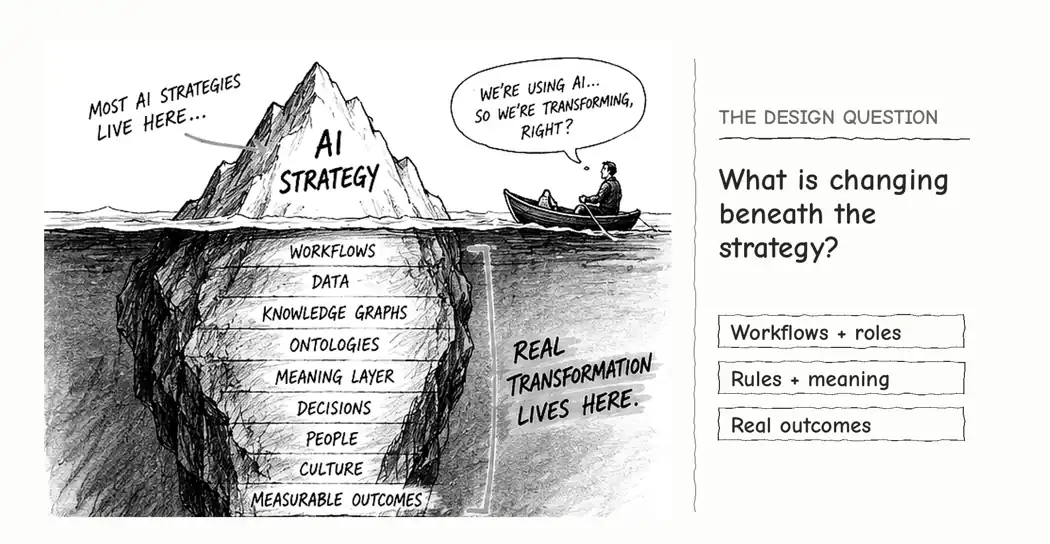
An AI strategy is only the visible tip. The deeper challenge is redesigning workflows, decisions, data and shared meaning across the organisation.
I’ve been thinking quite a bit about the gap between having an AI strategy and actually changing how work gets done. You can almost picture the leadership presentation: there’s an ambition, a set of principles, a technology roadmap and probably a handful of examples of where people are already using AI. None of that is necessarily wrong. But I do wonder how often we get to the rather less glamorous question of what Monday morning is supposed to look like for the people doing the work.
Imagine a customer request that passes through a frontline team, then operations, perhaps a specialist risk function, and eventually someone responsible for delivery. We could give each group an AI assistant and make the drafting, searching and summarising quicker. There would almost certainly be time saved. But the request would still pass through exactly the same boundaries, with the same approvals and, quite possibly, the same information being entered three or four times. We’ve improved the individual steps without really challenging the journey.
That’s where workflow redesign interests me much more than another conversation about AI tools. If we were designing this process from scratch, would we structure it in the same way? Which activities are genuinely creating value? Which decisions actually need a different person to make them? Where does someone need judgement, and where are we simply handing work around because that’s how we’ve always done it? I think those questions need to come before the decision about where an agent or model might fit.
There’s another layer to this which I’ve been exploring through the Meaning Layer prototype on Design My Thinking. Once you start talking about connected workflows, you very quickly run into a different problem: people and systems don’t always mean the same thing when they use the same language. What counts as a customer? What does 'eligible' mean in one business area compared with another? What makes something an approved exception? Ontologies, knowledge graphs and semantic or meaning layers sound quite technical, but at heart they’re ways of making those definitions, relationships and rules explicit enough for people and AI systems to work with them more reliably.
I like the idea of an iceberg as a visual for this. The AI strategy is what we can see above the surface. Underneath sit the workflows, the decision rights, the data, the governed meaning, the people, the culture and, importantly, the measures of success. These are not just technology choices. They are design decisions about the organisation. If we neglect what sits below the waterline, we can end up with a very impressive strategy attached to an operating model that hasn’t changed very much at all.
If I were designing a workshop around this, I’d resist starting with a list of AI use cases. I’d start with one real end-to-end journey. Get the people who understand it into the room, ask them to describe how it actually works, where it gets messy and what they would change if given the opportunity. Only then would I begin introducing the possibilities of AI, with the necessary risk and technical perspectives alongside them. You could finish with a small number of redesigned workflow concepts and some genuine experiments to test them, rather than another long list of tools people could try.
I’m not suggesting that every AI implementation needs a wholesale organisational redesign. Sometimes a better tool really is enough. But if the ambition is transformation rather than incremental efficiency, I think we need to be prepared to look beneath the waterline. Otherwise we may simply be making yesterday’s way of working a little bit faster.