Your Organisation Has 47 AI Experiments. Which Three Deserve to Survive?
What are we actually choosing when we choose which AI experiments survive?
Forty-seven experiments, limited capacity and competing sponsors. Designing a fair, useful conversation to make the difficult AI portfolio decisions.
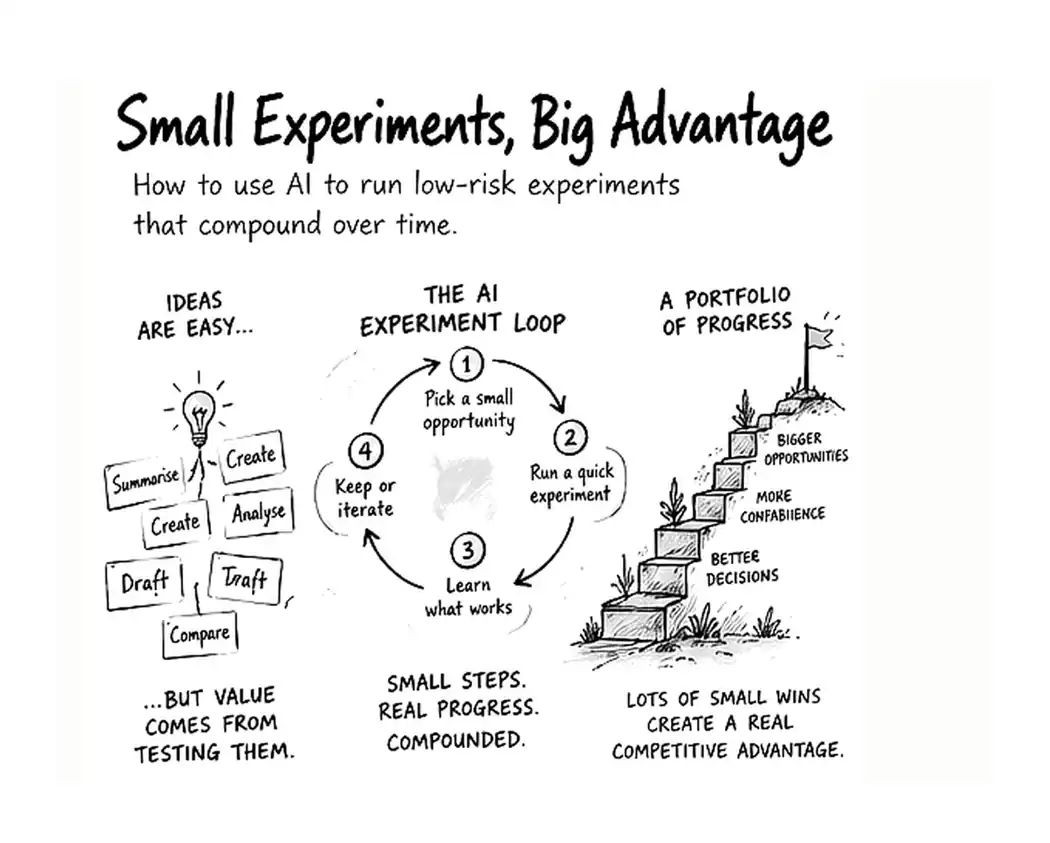
Let’s imagine a fairly familiar situation. An organisation has encouraged its teams to experiment with AI, and people have taken that encouragement seriously. There are now 47 experiments underway. Some have produced promising results, some are still more idea than experiment, and a few seem to exist largely because someone senior is excited about them. Almost all have a sponsor. How do you decide which ones get the next round of investment?
My instinct here isn’t to reach for a scoring spreadsheet. It’s to think about the design of the conversation. Because the first difficult decision isn’t which three experiments survive. It’s what the organisation is actually trying to optimise for. Are we looking for near-term efficiency? Better customer outcomes? New revenue? A new capability that might take a year or two to mature? Is it better to concentrate our effort within one business vertical, or to back a smaller number of opportunities that connect across the enterprise? Those are different portfolio strategies, and I’d want the sponsor to have wrestled with them before we brought a larger group together.
The next problem is that people can only make comparative decisions if they have something comparable to work with. In most workshops, each team knows its own initiative in great detail and has a fairly superficial understanding of everyone else’s. So I’d invest in the pre-work. I’ve been leaning increasingly towards simple, interactive HTML pre-reads for this sort of thing: short, visual, consistent summaries that people can browse before the session. For each experiment I’d want to see the problem, intended user, hypothesis, evidence to date, likely cost, dependencies, risks and what the next test would actually tell us. Not a fifty-slide deck. Just enough to arrive informed.
Within the workshop itself, a couple of LUMA methods come to mind. I’d use a variation of the Concept Poster, perhaps combined with a future newspaper headline, so each team has to explain the potential impact of its experiment in plain language. What would we be celebrating if this worked? What changed for the customer or colleague? What evidence would convince us? The discipline of translating an experiment into a recognisable future outcome can be surprisingly revealing.
From there, a simple two-by-two—perhaps value against effort—gives the group a way to make some of the trade-offs visible. I wouldn’t pretend that a matrix makes the decision. It doesn’t account neatly for dependencies, concentration risk or the fact that a technically difficult experiment might be strategically important. But it gives people something to react to, challenge and build on. That’s often far more productive than taking turns advocating for our own favourites.
I’d also bring in a three-horizon view. An experiment might be valuable because it can demonstrate an improvement in the next three months; another because it establishes data or decision foundations for the following year; another because it opens up an entirely different service model over a longer period. We probably don’t want three versions of the same quick win, nor three very speculative bets with nothing to show for them in the meantime. The shape of the portfolio matters as much as the individual ranking.
The session should finish with decisions people can actually act on: what we’re backing, what we’re stopping, what we’re parking, what evidence is still missing, who owns the next steps and when we will reconsider the choices. And I’d deliberately make room for a little disagreement, provided it is in service of a better decision rather than a contest between sponsors.
For me, the central question is whether those 47 experiments are genuinely helping the organisation learn, or whether we’re accumulating pilots because choosing is uncomfortable. A good workshop won’t eliminate uncertainty. It should make that uncertainty more visible and help the group decide what it is willing to learn next.