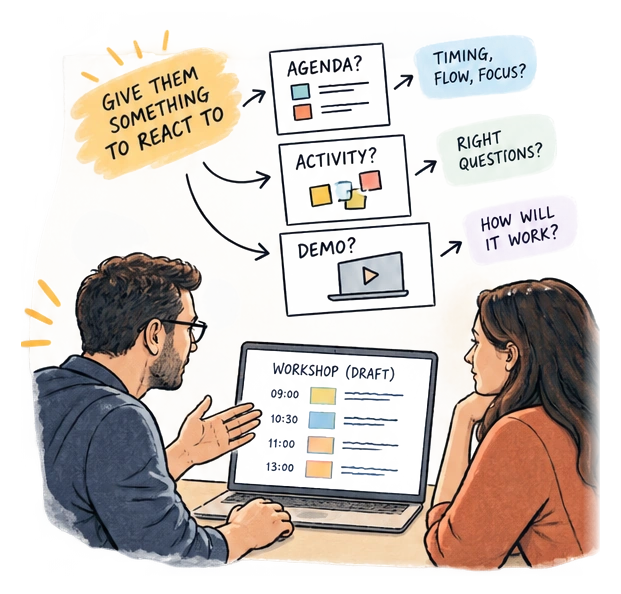
Give the sponsor something to react to.
What if one of the most useful things you could bring to a workshop design conversation was something unfinished?
The strongest workshop designs rarely arrive fully formed. They emerge through exploration, a few good challenges, and increasingly tangible drafts that help people react, rethink and refine.
Start with just enough to get going
When a sponsor first approaches me to design and facilitate a workshop, I usually send a very short note asking a few questions. What's the challenge we're trying to solve? Who needs to be involved? Is this face-to-face, virtual or hybrid? And roughly when are we hoping to bring everyone together?
That's generally enough to get started. The challenge is particularly important, not because I expect the sponsor to have defined the problem perfectly, but because it gives me a sense of the space we're operating in, the breadth of the issue and the people who might need to be involved.
I'll organise an initial half-hour conversation and spend a little time doing desktop research. Depending on the topic, I might look at the business context, relevant technology, competitors, market pressures, regulations or other stakeholders. I'm not trying to become a subject matter expert overnight. I'm trying to become informed enough to ask useful questions.
Let the conversation go where it needs to go
The first one or two design conversations are usually very exploratory. I don't arrive with a beautifully constructed agenda or a detailed set of activities. Beyond that initial research, there's often very little formal preparation. Instead, I want to hear the story.
Why is this important? What's happening today? Why now? What's changed? What have we tried before? What would a good outcome look like? How does this connect to the broader strategy?
As the sponsor talks, I find myself pulling on different threads. Something about technology might lead us into process. A comment about stakeholder engagement might reveal an issue with decision-making. A seemingly minor regulatory constraint might change what's possible. I think of these as the little shiny objects that emerge during a conversation: signals that something is worth exploring more deeply.
I try to explore them broadly. People, process, technology, strategy, regulation, customers, commercial outcomes. Whatever seems relevant to the problem. This is exploration with a purpose, rather than a predetermined destination.
Bring a brains trust, not just a brief
These conversations are even more useful when they include more than just the sponsor and me. Often we'll have two, three or four people involved: perhaps one or two workshop designers and another couple of people from the sponsor's side.
That small brains trust makes a real difference. Someone challenges an assumption. Someone remembers a dependency. Someone brings a different interpretation of the problem. A more complete, collectively understood picture starts to emerge.
There's something else worth acknowledging. I can't recall ever delivering a workshop where the problem we ultimately designed around was exactly the same as the problem the sponsor first brought to us.
That isn't a criticism of sponsors. Their initial brief is usually a thoughtful interpretation of the challenge, grounded in their responsibilities and experience. But it's still one perspective, sometimes shaped by a particular part of the organisation.
Other stakeholders bring different knowledge. And the workshop designers bring a relatively neutral perspective: we don't have a stake in one particular answer, but we do have a responsibility to ask questions, challenge assumptions and help everyone understand the problem more fully.
Sometimes the challenge becomes narrower, sometimes broader. Sometimes what first appeared to be a strategy problem turns out to be a decision-making problem, or a process problem is driven by different expectations between teams.
That reframing isn't a detour from workshop design. It is workshop design.
Eventually, put something on the screen
But here's the other part of the approach: you can't leave people staring at a blank canvas forever.
Once we've had the first one or two exploratory conversations, usually by around the third half-hour discussion, I'll start putting a rough agenda together. And when I say rough, I mean rough. Often it's simply an Excel spreadsheet shared on screen.
There might be blocks of time, proposed activities, an indication of what we're trying to achieve in each section and a few thoughts on how people could work together. Should we start with individual reflection? Do we need breakout groups? Who should be mixed with whom? Where does the whole room need to come together? What do we need to capture? What should one activity produce to make the next one useful?
Most importantly, does the proposed sequence take people on the journey we actually need them to go on?
At this stage I deliberately don't make it look finished. Because the point of putting it on the screen isn't to get approval. It's to give the sponsor something to react to.
Suddenly we're not discussing the workshop entirely in the abstract. People can see where time is being invested, what we're asking participants to do, what we're hoping to produce and where we've made assumptions.
The sponsor might say, “That group won't be ready to make that decision yet.” Or, “We need longer here.” Or, “Those two groups shouldn't be separated, because the tension between them is exactly what we need to explore.”
Those reactions are incredibly useful. We've created something tangible enough to expose new information and improve the thinking.
Rough is intentional. Reaction is the point.
There's a temptation to disappear for a while, build a sophisticated agenda, develop polished canvases and then return to the sponsor with something that looks almost complete. But the more finished something appears, the harder it can feel to challenge.
A rough spreadsheet gives us permission to change things. Move an activity. Question the sequence. Stretch or compress the timing. Replace a whole section. Reconsider what we're asking participants to produce. It becomes a working conversation, not a presentation.
As the design matures, so does what we're showing. By the fourth or fifth conversation, we might be looking at actual activity canvases, the questions participants will answer, an interactive HTML tool or a short AI-supported demonstration.
Again, the objective is the same. Can the sponsor picture how this will work? Are we asking the right questions? Will the activity generate something useful? Have we misunderstood anything? What should we change?
The design is the work before the work
A typical engagement might involve four or five half-hour conversations across several weeks, supported by research and preparation. The early calls are about exploring and reframing. Then we start making the agenda visible. Then we get increasingly specific about activities, tools, participant groupings and outputs.

And the actual design is always bespoke. Different people, different priorities, different constraints, different ways of interacting. A small senior leadership group doesn't need the same journey as a cross-functional team. A hybrid workshop isn't simply a face-to-face session with a camera switched on.
That's why I struggle with the idea that workshop design is just selecting activities from a catalogue and dropping them into time slots. The real challenge is understanding where the group needs to get to, then designing interactions that give them the best chance of getting there.
What must people understand first? Where should we diverge? When do we bring perspectives together? What decisions are we actually asking for? And what should exist at the end of the workshop that didn't exist at the beginning?
Be deliberate, but stay ready to adapt
I think about workshop engagements as two distinct but connected parts. There's the design: everything that happens in the lead-up. And there's the delivery: what happens when everyone comes together.
By the end of the design phase, the brains trust should have a much clearer view of the problem, a shared sense of what success looks like, and a purposeful sequence of activities and interactions.
Does that mean the day itself will unfold exactly as planned? Absolutely not. New information emerges, people challenge assumptions, conversations go somewhere unexpected, and sometimes a facilitator needs to pivot.
But a well-considered design provides the confidence to make those adjustments. We know why each activity exists, what it is intended to achieve, and what we might lose or gain by changing it.
Good workshop design doesn't eliminate the need to adapt. It gives us a better foundation from which to adapt.
Try it in the design conversation
Separate your early sponsor discussions into two modes. Start with exploration: listen, challenge, bring different perspectives into the conversation and resist the urge to leap straight to an agenda. Then, once you understand enough, share something deliberately unfinished. A rough agenda, a sketch of the participant journey, an early canvas or a working demo. Make the thinking visible and ask the sponsor to challenge it.
Watch for
Introducing a draft too early can anchor everyone to a solution before the problem is understood. But remaining in open exploration forever doesn't help either. And keeping the draft rough doesn't mean the thinking behind it should be careless. The skill is knowing when a tangible proposal will help the conversation move forward.