If all you're doing is presenting, do you really need a workshop?
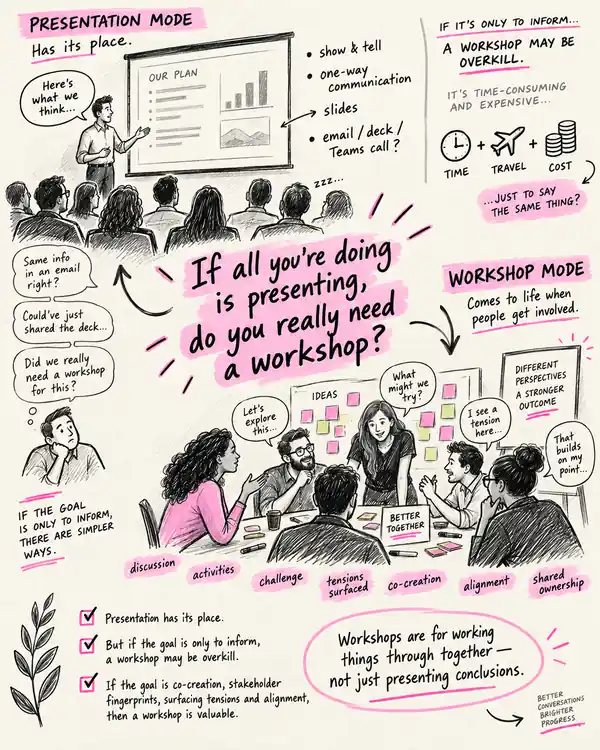
If the objective is simply to inform people, a workshop may be an expensive way to do something an email, a deck or a short call could do. The value starts when people are there to shape, challenge and align together.
The thought
I've seen this a few times.
A workshop sponsor, usually with very good intentions, has already put together the agenda before we really get into the design.
And on first inspection, it looks pretty good.
There's a logical sequence. Clear sections. Sensible timings. Breaks in the right places. Often quite a lot of thought and effort has gone into it.
But then you look a little closer.
Twenty minutes of context. Thirty minutes of research findings. Another presentation on the proposed approach. A project update. A presentation from another team. Questions at the end.
And you realise something.
Which raises a fairly simple question: if all you're doing is presenting, why do you need a workshop at all?
If the objective is simply to inform people, there are much easier ways to do it.
Send the deck. Write an email. Record a video. Run a short Teams call.
Do the research, make the decision, explain the logic and tell people where you're heading.
There is absolutely a place for that. But it's worth being clear about what it is.
It's communication, not co-creation.
Workshops should create something that wouldn't happen otherwise
Bringing a group of people together is expensive.
Not just in venue costs, travel or accommodation, but in the collective time of everyone sitting in the room.
Ten senior people spending half a day together is a significant investment.
So the question I increasingly find useful is:
That is where the value of a workshop starts to become clearer.
A good workshop creates space for people to:
- challenge assumptions
- hear different perspectives
- build on one another's thinking
- expose disagreements and tensions
- understand why others see the problem differently
- explore possibilities together
- make trade-offs
- gradually build alignment
- leave with some sense of shared ownership
Most of that doesn't happen while somebody is standing at the front of the room clicking through slides.
It happens in the conversations between people.
The presentation is often the smallest part
That doesn't mean workshops shouldn't contain presentations.
They often should.
People need context. They need evidence. They need to understand the problem they are being asked to work on.
But the presentation should usually be there in service of the conversation, rather than becoming the conversation.
Five or ten minutes of context might unlock forty minutes of valuable discussion.
A simple provocation might be more useful than twenty slides of explanation.
A piece of research might be introduced briefly, then handed over to participants to interrogate, challenge and build upon.
The aim isn't to demonstrate how much work has already been done.
The aim is to give people enough to work with.
There is also a difference between consultation and co-creation
Another version of this appears when a small team has already done a lot of excellent work.
They've conducted the research. They've analysed the options. They've developed the recommendation. They've mapped out the direction.
Then everyone else is invited into a workshop and walked through the answer.
Again, none of that work is inherently wrong.
Sometimes that's exactly what needs to happen.
But if we then describe the session as co-creation, we should probably challenge ourselves.
Because people can tell the difference between being invited to shape something and being invited to react to something that has already been decided.
If we genuinely want people to have their fingerprints on the outcome, there has to be something meaningful left for them to influence.
That might mean shaping the direction. Testing assumptions. Working through trade-offs. Identifying risks. Challenging the research. Prioritising options. Or simply surfacing tensions that haven't yet been resolved.
Without that space, participation can become theatre.
So perhaps the starting question isn't “What's the agenda?”
It might be:
If the answer is: “We need them to understand what we've decided.”
You may not need a workshop.
If the answer is:
- “We need their perspectives.”
- “We need to work through some difficult trade-offs.”
- “We need to expose disagreement.”
- “We need to build something together.”
- “We need people to leave with genuine ownership of the outcome.”
Then a workshop may be exactly the right tool.
And the agenda should reflect that.
Less time presenting conclusions. More time working things through together.
Because workshops aren't valuable simply because people are in the same room.
They're valuable because of what becomes possible when those people actually get involved.
Try it in the room
Before building the agenda, ask one question: what genuinely needs the room?
Put the information transfer elsewhere where you can. Pre-reading, a short deck, a recording or a concise opening can carry the context. Protect the face-to-face or live time for the parts that need interaction: sense-making, challenge, trade-offs, tension, decision-making and alignment.
If the important decisions are already fixed, say so. Consultation can still be useful, but don't design participation that implies people have influence they do not actually have.
Inform outside the room where you can. Use the room for the thinking that needs other people.
Watch for
- Presentation creep. Ten minutes of useful context quietly becomes forty-five minutes of slides.
- Participation theatre. People are asked for input even though the answer is effectively locked.
- Over-correction. Not every presentation is bad. Sometimes the room genuinely needs a shared fact base before it can work.
- False consensus. The goal isn't to remove disagreement; it is to make the important disagreements visible enough to work with.
- Activity for activity's sake. A workshop isn't made participative by adding Post-its. The interaction has to change the thinking or the outcome.