The value of a canvas.
Is your workshop canvas helping people think, or just giving them somewhere to put notes?
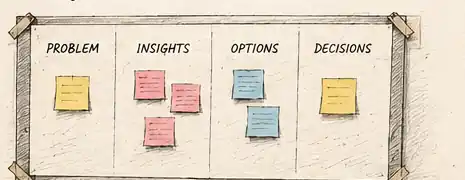
A canvas is not just somewhere to put Post-its. Its structure quietly tells a group what to notice, what to compare and how to move through a problem.
The thought
Every canvas contains a point of view. The headings, sequence, size of boxes and amount of space given to each prompt all influence what participants spend time thinking about. That makes the canvas part of the facilitation design.
Why it helps
- Creates a shared visual field for the group.
- Reduces cognitive load by making the sequence visible.
- Helps participants compare and connect ideas rather than simply accumulate them.
Try it in the room
Start with the thinking you need, not a favourite template. Ask what participants must notice first, what deserves equal weight, what should be compared, and what needs to converge into a decision.
Watch for
An inherited canvas can make a group solve the wrong problem very efficiently. More boxes also do not mean more rigor. If a section does not change the next piece of thinking, question whether it belongs.