AI Saved Us 10,000 Hours. So Where Did the Value Go?
Saving hours is one thing. Deciding where those hours go is another.
AI efficiency gains create banked time, not automatically cash savings. Who decides where that capacity goes next?
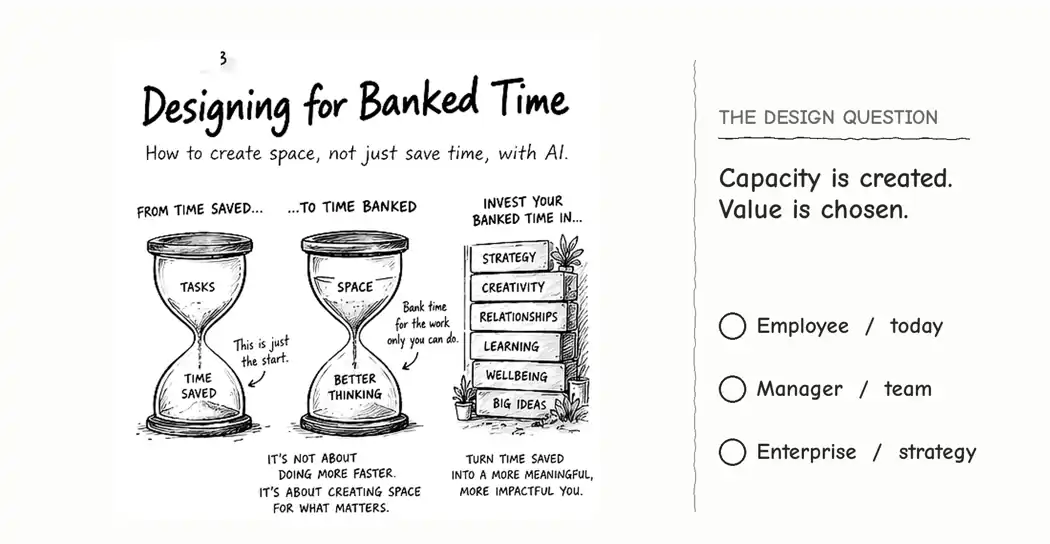
Suppose a team used to need five days to get through its weekly work and, with some well-designed AI support, it now needs four. On paper, that looks like a 20 per cent productivity improvement. It might well be a meaningful one. But if the same team is still employed, the same budget is in place and the same services are being delivered, where exactly has the value gone? I think this is one of the more interesting conversations for leaders to be having as AI moves beyond experimentation.
I’ve started thinking about it as 'banked time'. We’ve created capacity, but creating capacity and realising a business benefit are not the same thing. Perhaps people finish earlier or carry a slightly lighter load. Perhaps they use the extra space to learn new skills, try something they’ve had on their list for months, help colleagues, or simply spend more time talking to people elsewhere in the business. None of those things is automatically a poor outcome. Some might be exactly what the organisation needs. But we should be deliberate about it rather than assume a saving has somehow materialised in the accounts.
What I find particularly interesting is the question of who gets to make that decision. My answer is probably all three: the employee, the manager and the organisation. They just see the opportunity through different lenses and over different horizons. An individual can make choices on the spot. A manager can look across a team, shift work around and perhaps remove bottlenecks. At an organisational level, there are larger choices around service capacity, investment, restructuring, revenue-generating activity or building new capabilities.
The scale matters. One person might recover half an hour here and there. That can be useful, but it isn’t necessarily a block of time you can simply move to a completely different job. A team might be able to combine those fragments into a more meaningful change. And at enterprise level, the question becomes whether the capacity is in the right places to support a broader strategic shift. A claimed 10,000 hours saved across a business can mean very different things depending on where the hours came from and whether they can realistically be redeployed.
There’s a useful distinction to make between hours released, capacity deliberately redirected, and outcomes eventually realised. The first might be measurable quite quickly. The second requires decisions. The third may show up much later as cost reductions, additional throughput, improved customer experience, better-quality work, new revenue or a stronger pipeline of ideas. Some of those outcomes are easier to attach a dollar figure to than others. I’m not sure we help ourselves when we pretend they can all be treated as a single category of 'AI savings'.
I can imagine a really useful visual for this: a workflow with a green tick beside 'productivity gain achieved', followed by a rather large box saying 'Now what?'. Beyond that would be several possible paths—reinvest in people and learning, improve products and services, increase revenue capacity, reduce costs, or take a balanced approach. It’s almost a second design challenge sitting immediately behind the first one. We’ve made the work more efficient; now we need to decide what to do with the opportunity that creates.
For me, that is also a facilitation opportunity. Bring the right leaders together, make the gains tangible, agree what can genuinely be redeployed and then have the harder conversation about priorities. Efficiency can enable cost reduction, but it is not the same thing as cost reduction. And sometimes the most valuable use of banked time will be something that didn’t appear in the original business case at all.