The AI Pilot Worked. The Organisation Didn’t.
How do we keep the alignment from the workshop alive after everyone goes back to work?
Why a successful AI pilot often loses momentum in business as usual, and how a deliberate rhythm of learning and decision-making sustains change.
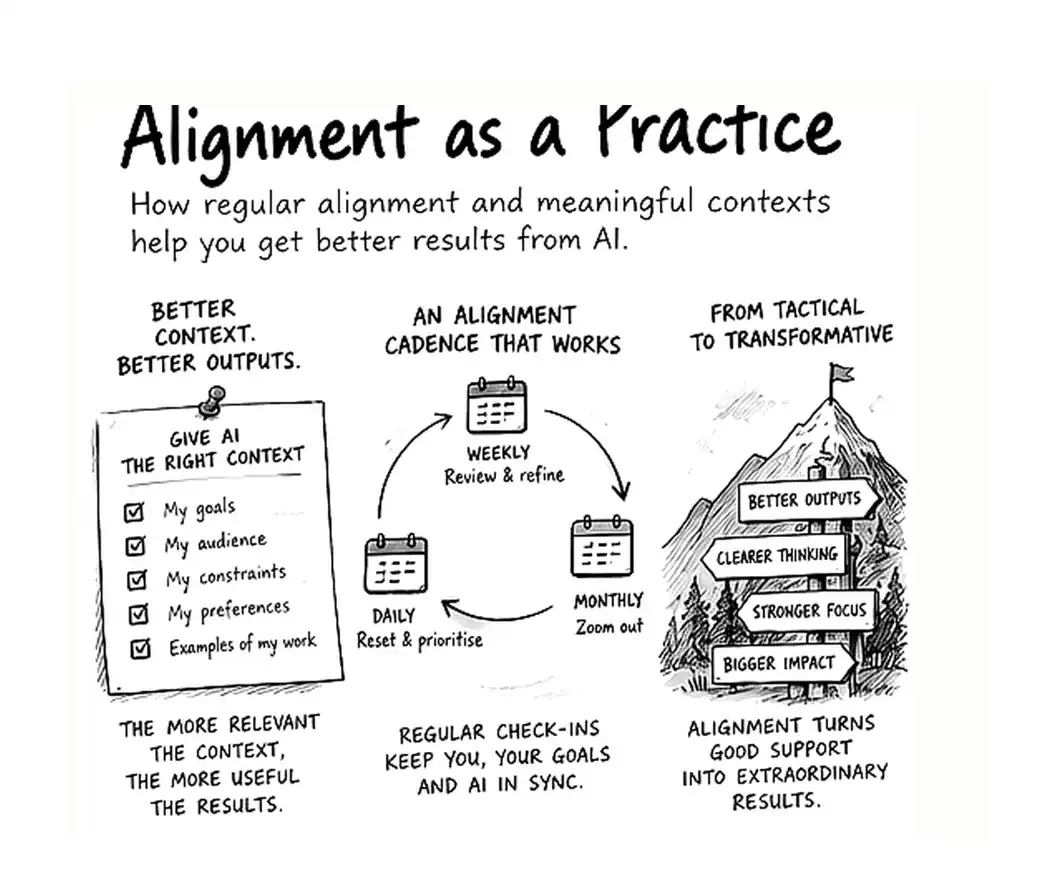
I’ve been thinking about the life of a workshop after everyone leaves the room. You know the feeling at the end of a good one: people have contributed, the big decisions have been made, the actions are clear and, for a little while at least, everyone is singing from the same hymn sheet. We’ve probably had a productive day. But then the diaries fill up again. People return to business as usual, something unexpected happens, and a few weeks later the clarity that felt so strong in the room has started to fade.
It isn’t necessarily because the workshop failed. In fact, I think it’s often a perfectly normal consequence of people returning to an organisation that keeps moving. Priorities shift, information changes, dependencies that looked straightforward turn out to be awkward, and different teams begin interpreting the original agreement in slightly different ways. The really important work begins after the apparent moment of alignment.
There’s a parallel here with AI pilots. We can run a technically sound experiment, show that the model performs well enough for a particular task and produce an impressive demonstration. Then we move towards implementation and discover that changing the way people work is an entirely different problem. Who owns the redesigned workflow? Who changes the upstream process? What happens when the promised data isn’t available? And which person has the authority to resolve a conflict between two teams when both have reasonable concerns?
The Double Diamond is useful for thinking this through, although perhaps not in the tidy, linear way it sometimes appears on a slide. We diverge to understand a problem, converge on a direction, explore possibilities, and eventually commit to something to test or deliver. But implementation creates a whole new set of discoveries. New evidence emerges. The organisation diverges again, whether we’ve planned for it or not. If we don’t create opportunities to bring people back together and reconverge, alignment gradually becomes a memory of something everyone once agreed to.
That’s why I’m interested in designing a cadence rather than a single heroic workshop. There may be a full-day session at the start to shape the future state, surface the difficult questions and make some meaningful decisions. Then, perhaps four weeks later, a shorter session brings the same core people back together. Not for a ritual 'check-in' or a status report. I’d want the conversation to be about what we’ve actually done, what we’ve learned, what is now getting in the way and what we need to decide differently as a result.
Repeat that at eight or twelve weeks, with the cadence adapted to the size and pace of the change. Some sessions might focus on unresolved cross-functional dependencies. Others might ask whether the expected value is showing up or whether our assumptions about adoption were right. The critical point is that the people in the room can make, or at least meaningfully influence, the decisions required. Otherwise it risks becoming another meeting that creates actions for somebody else.
There’s a design challenge in keeping these sessions worthwhile. I’d want individual reflection before the group discussion, real evidence rather than optimistic updates, and a visible record of what has changed since the last time we met. The output should be a small number of refreshed decisions and commitments—not a beautiful mural that nobody looks at again.
So perhaps the stronger question isn’t just whether the AI pilot worked. It’s whether we’ve designed the rhythm of conversations, decisions and learning that will allow the organisation to keep changing after the pilot is over. I suspect that can make the difference between a promising demonstration and something that genuinely sticks.