Sometimes the quiet should come last.
When does individual reflection work better after the group conversation?
We often design workshops to build from the individual up. But sometimes the most useful insight comes when we start with the big picture together, then gradually zoom in toward the individual.
The thought
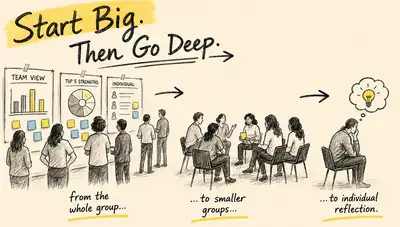
Collaboration does not have to start with the individual. There can be real value in doing it in reverse: start with the full group, move to smaller groups, then finish with individual reflection.
In a recent workshop exploring Gallup Strengths, we started with the team view of the data, moved into small groups using handwritten cue cards, and finally gave people quiet space to reflect on what the team picture and other people's perspectives meant for them personally.
The result was richer conversation and deeper individual insight.
Why it helps
- Builds shared context and a common language early.
- Helps people see the bigger picture first.
- Small-group conversations become more meaningful and focused.
- Individual reflection is deeper because it is informed by others' perspectives and the team view.
- Encourages natural connection and trust.
Try it in the room
- Prepare ahead. Gather and print large-format team and individual data.
- Start together. Introduce the content and how to read it, then give people time to absorb the visuals.
- Cue cards, not slides. Write four focused questions on A5 cards, make enough sets for the room, and hand each set to a random person.
- Small-group conversations. Invite people to self-select into groups of four or five and give them six or seven minutes to explore a mix of individual and team questions.
- Individual reflection. Finish with quiet time to reflect on personal results, informed by the conversations and the team view.
See together → talk together → think alone.
Watch for
- People clustering with their usual allies — encourage mixed groups.
- Over-talking in groups — set a clear time boundary and keep it visible.
- Skipping the individual reflection — protect that quiet thinking time.
- Too many questions — keep it focused and purposeful.