Scenarios stretch thinking.
How do you stop a strategy workshop being limited by today's assumptions?
When a group is anchored to today's constraints, asking them to imagine a few plausible futures can expose assumptions that an ordinary planning conversation never reaches.
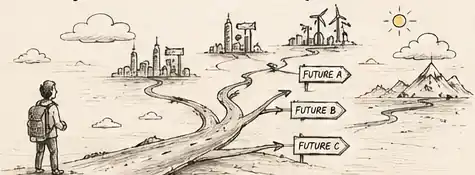
The thought
Most planning starts from an implicit assumption that tomorrow will be a slightly altered version of today. Scenarios interrupt that habit. They give a group permission to ask what changes if the context changes — and which current assumptions suddenly stop being useful.
Why it helps
- Makes hidden assumptions easier to see.
- Creates distance from today's politics and constraints.
- Tests whether a decision is robust across more than one plausible future.
Try it in the room
Offer two or three deliberately different but plausible futures. Ask: what becomes more important, what breaks, what would we regret not preparing for, and which decisions still make sense in every scenario?
Watch for
A scenario is not a prediction exercise and it is not theatre. If the imagined future does not change the questions the group is asking, it probably is not stretching the thinking enough.